What Is Rum Made From? Ingredients, Process & Types Explained
On this page
TL;DR: Rum is made from sugarcane. Most rum starts as molasses, the thick, dark syrup left behind when sugar is refined. Some rum is made from fresh cane juice or cane syrup instead. The base gets mixed with water and yeast, fermented, distilled, and usually aged in oak barrels. Different bases, stills, and ageing methods give us white, gold, dark, spiced, and overproof rums.
Most people know they like rum. Ask them what it's actually made from, and you'll usually get a shrug or a vague guess about sugar. So let's clear it up properly. The question of what is rum made from has a short answer (sugarcane) and a much longer, more interesting one underneath.
This guide walks you through the ingredients, how rum is produced, the main types, and what gives each one its personality. No jargon, no chemistry lecture. Just a clear run-through of how this Caribbean classic ends up in your glass, whether you're sipping it neat, mixing a mojito, or cracking open a chilled can.
So, What Is Rum Made From?
Rum is made from sugarcane, full stop. But there are three forms of sugarcane that distillers actually use, and the choice shapes everything that follows.
The first is molasses, the thick, dark, treacly liquid left over after sugar is crystallised out of cane juice. The second is fresh sugarcane juice, pressed straight from the cane. The third is cane syrup, which is cane juice that's been concentrated by boiling but hasn't had the sugar crystals removed.
In the UK, rum is a legally defined drink. According to GOV.UK's guidance on labelling spirit drinks, a product can only be called "rum" if it meets the rules set out under retained EU spirit drinks regulations. That means it must come from cane sugar molasses, cane syrup, or cane juice, and it must be bottled at a minimum of 37.5% ABV. Anything else, no matter how rum-like it tastes, has to go by a different name.
So if the bottle says rum on the label, you can trust it started life as sugarcane.
Why Molasses Is the Most Common Base
Around 95% of the world's rum is made from molasses, and there's a good reason for that.
Molasses is what's left when sugar mills crush sugarcane, boil down the juice, and spin out the sugar crystals to sell as table sugar. The dark, syrupy stuff that remains used to be treated as waste. Then someone in the 17th-century Caribbean worked out that you could ferment it and turn it into a strong, warming spirit. Rum was born.
Molasses is cheap, stores well, and is packed with leftover sugars that yeast feeds on. It also brings deep, rich, almost burnt-sugar notes to the final spirit, which is why molasses-based rums tend to taste fuller and more robust than rums made from fresh cane juice. The darkest, lowest-grade molasses is called blackstrap, and it gives some of the boldest rums their backbone.
A Quick Note Before We Talk Production
This post explains how rum is made commercially. Distilling spirits at home in the UK is illegal without a licence from HMRC, so what follows is for curiosity and appreciation, not a how-to guide.
How Rum Is Made, Step by Step
The process is simpler than you'd think. Four stages, each one shaping the final drink. If you want a deeper walkthrough, our page on how rum is made goes into more detail, but here's the short version.
Stage 1: Harvesting and prep. Sugarcane is cut by hand or by machine, then crushed at the mill to extract the juice. From there, the distiller picks a base: keep the juice fresh, boil it down to syrup, or process it into molasses.
Stage 2: Fermentation. The chosen base is mixed with water in big vats, and yeast is added. The yeast eats the sugars and produces alcohol. This stage usually takes one to several days, and the length matters more than people realise. A short, fast ferment makes a light, clean rum. A long, slow ferment, sometimes lasting weeks, builds up rich, funky, almost fruity flavours.
Stage 3: Distillation. The fermented liquid, now sitting at around 5-10% alcohol, is heated in a still. Because alcohol boils at a lower temperature than water, the alcohol turns to vapour first. That vapour is captured, cooled, and condensed back into a much stronger, clearer liquid.
Stage 4: Ageing. Most rum then goes into oak barrels to rest, sometimes for a year, sometimes for twenty. This is where colour and depth develop. Some rums skip this step or are filtered afterwards to stay clear.
Pot Stills vs Column Stills
The type of still a distillery uses has a big impact on the finished rum, and it's one of the most overlooked parts of the whole story.
Pot stills are the old-school option. Big copper kettles, used one batch at a time. The fermented liquid is heated, the vapour rises, gets condensed, and you collect the spirit. Pot stills are slow and a bit less efficient, but they leave more of the original flavour compounds in the rum. The result is a heavier, richer, sometimes funkier spirit. Most Jamaican rums lean on pot stills, which is why they taste so bold.
Column stills, also called continuous stills, are tall, multi-chambered towers that run non-stop. The wash flows in one end, gets distilled through a series of plates, and comes out the other end stronger and cleaner. Column stills are efficient and produce a lighter, smoother rum. Most Cuban and Puerto Rican rums are made this way.
Some distilleries use both, blending pot-still rum for character with column-still rum for smoothness. Barbados is famous for this hybrid approach.
Ageing in the Barrel
Once distilled, rum is usually moved into wooden barrels to age. The vast majority of those barrels are ex-bourbon casks, because the Americans only use their barrels once for whiskey and then sell them on.
Inside the barrel, three things happen. The rum pulls colour and flavour out of the wood (vanilla, caramel, spice, toasty oak). Harsh notes mellow as the spirit interacts with tiny amounts of oxygen. And a chunk of the liquid evaporates through the wood, a loss known as the angel's share.
Climate plays a big role here. In the hot, humid Caribbean, barrels can lose 7 to 10% of their contents to the angel's share every year. In cooler European cellars, that drops to around 2 to 3%. So Caribbean rum ages roughly three times faster than spirits aged in cooler climates. A five-year Caribbean rum has often picked up as much wood character as a fifteen-year Scotch.
One more thing worth knowing: dark colour doesn't always mean long ageing. Some rums get their deep brown from added caramel colouring. It's perfectly legal under UK rules, but it's why the age statement on the bottle matters more than the shade.
The Different Types of Rum
Once you understand the base, the still, and the ageing, the different types of rum start to make sense.
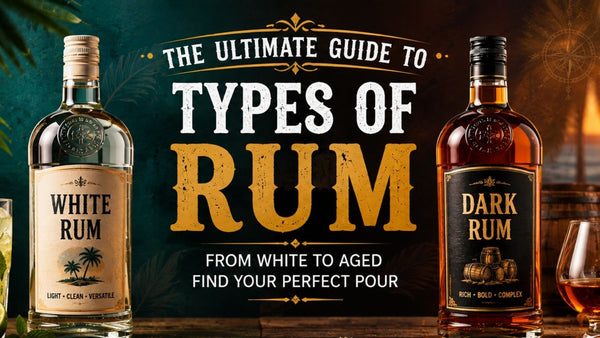
White rum is light, clean, and usually unaged or filtered after a short rest to keep it clear. It's the workhorse of the cocktail world, the rum behind every classic mojito and daiquiri.
Gold rum has spent a few years in oak. It's smoother and rounder than white rum, with notes of vanilla and caramel. Good for cocktails that need a bit more body.
Dark rum is aged longer in charred oak barrels and often made from heavier molasses. Think rich, toffee-like, almost burnt sugar. Brilliant in a dark 'n' stormy.
Spiced rum is a gold or dark rum that's been flavoured with spices like cinnamon, vanilla, clove, and nutmeg. Easy to drink, often a touch sweet.
Overproof rum is bottled at much higher strength, anywhere from 57% to 75% ABV. Built for tiki cocktails, floats, and people who know what they're doing.
Rhum agricole is the odd one out. Made from fresh sugarcane juice rather than molasses, almost entirely produced in the French Caribbean, and bottled with a distinctly grassy, vegetal character.
If you want a closer look at how these types play out in everyday drinking, our take on the rise of Caribbean-inspired drinks covers the cultural side of it.
Where Rum Comes From
Rum is made all over the world, but most of it still traces back to three Caribbean traditions, each shaped by the country that once colonised those islands.
British-style rums come from places like Jamaica, Barbados, and Guyana. They tend to be bold, full-bodied, and often funky, especially the Jamaican ones, which are famous for their intense fruit and ester-driven flavours. Jamaican rum even has a protected geographical indication, much like Champagne or Scotch.
Spanish-style rums come from Cuba, Puerto Rico, the Dominican Republic, and Nicaragua. These are lighter, smoother, and built for sipping or for crisp, clean cocktails. The Cuba Libre, the daiquiri, and the mojito all grew up in this tradition.
French-style rums, mostly from Martinique and Guadeloupe, are the rhum agricole crowd. Made from fresh cane juice, distilled in column stills, and bottled with a grassy, herbal personality that stands apart from the molasses-based world.
If you ever wonder why two bottles both labelled "gold rum" can taste completely different, this is usually why.
Final Thoughts
So, what is rum made from? Sugarcane, in one of three forms, fermented with yeast, distilled in a pot or column still, and often aged in oak. Every choice along the way (base, ferment time, still type, barrel, climate) leaves its mark on the final spirit. That's why rum has more variety than almost any other category of booze.
You don't need to memorise all of this to enjoy a great rum drink. You just need to know what you're in the mood for. Light and refreshing? Reach for a mojito. Rich and warming? Pour something dark. Want all the Caribbean character without the prep, the measuring, or the washing up? That's exactly what we built Satchmo rum cocktails for. Real rum, real flavour, ready in a can.
Please drink responsibly.
Frequently Asked Questions
Is rum made from sugar or sugarcane?
Both, in a way. Rum is made from sugarcane, but usually in the form of molasses, which is the thick syrup left over after sugar is refined from the cane. Some rums are also made from fresh sugarcane juice or concentrated cane syrup. So the raw material is always cane, but the form it takes when it goes into the still varies.
Is rum gluten free?
Yes. Rum is made from sugarcane, not from any grain, so it's naturally gluten free. Spiced and flavoured rums add botanicals after distillation, but the base spirit itself contains no gluten. If you have severe coeliac disease, it's always worth double-checking the label for any added ingredients.
What's the difference between rum and rhum?
"Rhum" with an h is the French spelling, and it usually refers to rhum agricole, made from fresh sugarcane juice in the French Caribbean. "Rum" without the h is the broader category, mostly made from molasses, and produced everywhere from Jamaica to the Philippines. Same family, different traditions.
Why does Caribbean rum age faster than Scotch whisky?
It's down to the climate. Caribbean warehouses are hot and humid, so the rum expands and contracts inside the barrel much more aggressively than spirits aged in cool Scottish cellars. That speeds up how quickly the rum pulls flavour from the wood. The trade-off is a bigger angel's share, with up to 10% of the liquid evaporating each year compared to 2 to 3% in cooler climates.
Is dark rum stronger than white rum?
Not necessarily. Most white and dark rums sit around 37.5% to 40% ABV, the legal minimum for rum in the UK. The colour comes from ageing in oak or from added caramel, not from extra alcohol. If you want a stronger pour, look at overproof rums, which can run from 57% all the way up to 75% ABV.
Ready to try Satchmo?
16% ABV. Real Caribbean rum. Bar-quality cocktails in a can — free delivery across the UK.