The Ultimate Guide to Rum: Origins, Types, Flavours & How to Drink It
On this page
TL;DR: Rum is a distilled spirit made from sugarcane, usually from molasses but sometimes from fresh cane juice. It was born in the 17th-century Caribbean and must be bottled at a minimum of 37.5% ABV to be called rum in the UK. The category covers white, gold, dark, spiced, overproof, and rhum agricole, with flavours ranging from light and crisp to rich and treacly.
Rum is one of those drinks everyone has tried, but very few can actually define. It's on every back bar, in every supermarket, and behind half the cocktails you order on holiday. Ask someone what is rum, though, and you'll usually get a vague answer about pirates, the Caribbean, or sugar.
This guide gives you the full picture without the jargon. We'll cover what rum actually is, where it came from, what it tastes like, how it stacks up against other spirits, and the best ways to enjoy it. Whether you're a complete beginner or just want to fill in the gaps, you'll walk away knowing your white from your dark, and your mojito from your dark 'n' stormy.
So, What Is Rum?
Rum is a distilled alcoholic spirit made from sugarcane. Most rum starts as molasses, the thick, dark syrup left behind when sugar is refined from sugarcane juice. Some rum is made directly from fresh cane juice or cane syrup instead.
In the UK, rum is a legally defined category. According to GOV.UK's guidance on labelling spirit drinks, a product can only be sold as "rum" if it meets the rules set out under the retained EU spirit drinks regulations. The minimum strength is 37.5% ABV, and the base must come from sugarcane molasses, cane syrup, or cane juice. Anything that doesn't meet those rules has to go by a different name.
If you want the full breakdown of what rum is made from and how it's produced, we've covered the production side in a separate guide. This article keeps things focused on rum the drink: where it came from, how it tastes, and how to enjoy it.
A Short History of Rum
Rum's story starts in the 17th-century Caribbean. The first recorded production happened in Barbados around 1650, where plantation workers discovered that the molasses left over from sugar making could be fermented and distilled into a strong, warming spirit. It was rough, harsh, and not pleasant to drink. Early names included "kill-devil" and "rumbullion" (an old English word for a noisy disturbance), which tells you everything about how it tasted in those days.
The drink quickly caught on with sailors. In 1655, when British ships took Jamaica, the Royal Navy gained easy access to Caribbean rum and replaced the standard daily beer ration with it. The famous daily "tot" of rum was born, and it stayed part of Royal Navy life for over 300 years. Sailors would even pour rum onto gunpowder and try to light it to prove the strength: if the gunpowder still burned, the rum had been "proved." That's where the word "proof" comes from in alcohol measurement.
The daily rum ration finally ended on 31 July 1970, a day still known in the Royal Navy as Black Tot Day. By that point, rum had already shaped centuries of trade, travel, and Caribbean culture. It's the reason we still associate rum with sailors, sunshine, and the sea today.
What Does Rum Actually Taste Like?
Rum is one of the most flavour-varied spirits in the world. It can be light and citrusy, or dark and treacly. It can taste like vanilla ice cream or burnt caramel. The base ingredient, the still, and the ageing all play a part.
Most rums share a few common notes. Vanilla, caramel, toffee, brown sugar, and tropical fruit are the flavours you'll come across most often, picked up from the sugarcane base and the time spent in oak barrels. Spiced rums add warming notes like cinnamon, clove, nutmeg, and orange peel on top.
One of the biggest misconceptions about rum is that it has to be sweet. Quality rum often carries a natural sweetness from the cane, but proper rum isn't sugary like a liqueur. Some premium rums are dry, complex, and can even taste a bit like an aged whisky.
Lighter white rums tend to taste clean, crisp, and slightly fruity. Gold rums are smoother and rounder. Dark rums lean into deep flavours like molasses, dried fruit, cocoa, and burnt sugar. Once you know the style, you'll have a decent idea of what's in the glass before you sip.
How Rum Is Different from Other Spirits
If you've ever wondered what actually separates rum from whisky, vodka, gin, or tequila, the answer comes down to one thing: the base ingredient. Each spirit starts from something different, and that shapes the flavour from the ground up.
Rum is made from sugarcane (mostly molasses, sometimes fresh cane juice). The natural sweetness of cane carries through into the finished spirit, even in dry styles.
Whisky is made from fermented grain (barley, corn, rye, or wheat). It's almost always aged in oak, and the grain bill plus the barrel determine the flavour. Tends to taste cereal-like, smoky, or oaky.
Vodka is made from pretty much anything fermentable (grain, potatoes, sometimes even grapes or molasses). It's distilled to a very high purity, so it tastes neutral on purpose.
Gin is essentially a flavoured vodka. It starts as a neutral spirit and is then redistilled with botanicals, with juniper as the lead note. The flavour comes from the herbs, not the base.
Tequila is made from the blue agave plant and is produced only in Mexico. It has an earthy, vegetal character that's instantly recognisable.
So if rum tastes warmer, rounder, and a touch sweeter than the others, that's the sugarcane talking.
The Main Types of Rum
Once you know what rum is, the different styles start to make sense. Here's a quick overview, with a link to our deeper guide if you want more detail.
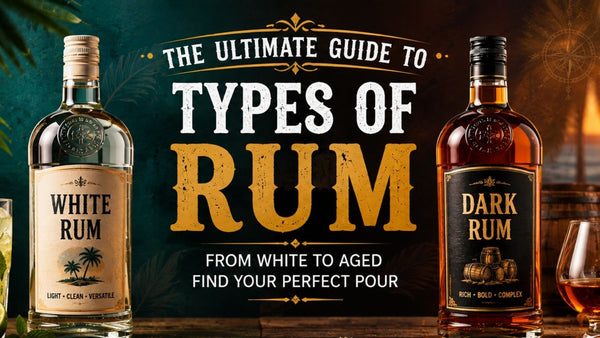
White rum is light, clear, and clean. It's usually unaged or filtered after a short rest, and it's the rum behind classics like the mojito, daiquiri, and piña colada.
Gold rum has spent a few years in oak. It's smoother, with notes of vanilla and caramel, and works well in cocktails that need a bit more body.
Dark rum is aged longer in charred oak barrels and often made from heavier molasses. Expect rich, toffee-like, almost burnt sugar flavours. Great in a dark 'n' stormy.
Spiced rum is a gold or dark rum that's been flavoured with spices like cinnamon, vanilla, clove, and nutmeg. Easy to drink, often slightly sweet, and one of the most popular rums in the UK.
Overproof rum is bottled at much higher strength, anywhere from 57% to 75% ABV. Made for tiki cocktails and floats, not casual sipping.
Rhum agricole is the odd one out, made from fresh cane juice rather than molasses, almost entirely in the French Caribbean. Grassy, herbal, and very distinctive.
For a fuller walkthrough of how each style is made, see our piece on what rum is made from and how it's produced.
How to Drink Rum
There's no wrong way to drink rum, but there are a few classics worth knowing.
Neat or on the rocks. Aged rums, especially gold and dark ones, are built for slow sipping. Pour a small measure into a tulip glass or a heavy tumbler, add ice if you like, and take your time. This is the best way to actually taste the rum.
In cocktails. This is where rum really shines. White rum is the backbone of the mojito and daiquiri. Gold rum gives a Mai Tai its depth. Dark rum is the star of the dark 'n' stormy and rum punch. Spiced rum is brilliant with cola or ginger ale. You can't really go wrong, which is why rum is the spirit of the summer for so many people.
With mixers. Rum and Coke is the classic for a reason. Rum and ginger beer is just as good. A squeeze of lime lifts both.
In a can. The simplest option of all. Pre-mixed rum cocktails give you the real flavour of a bar-quality drink without the mixing, the measuring, or the trip to the bottle shop. Our roundup of the top ready-to-drink cocktails in the UK covers the best options on the market right now.
Final Thoughts
So, what is rum? At its simplest, it's a distilled spirit made from sugarcane, born in the Caribbean and shaped by centuries of trade, travel, and tradition. At its best, it's a hugely varied category that can give you anything from a crisp summer cocktail to a slow, oaky sip by the fire.
You don't need to be a rum nerd to enjoy it. You just need to know what you're in the mood for. Light and refreshing? Reach for a white rum and a mojito. Warm and rich? Pour something dark over ice. Want the full Caribbean-inspired drinks experience without the prep? Crack open a can of Satchmo rum cocktails and you're sorted.
Please drink responsibly.
Frequently Asked Questions
Is rum stronger than whisky?
Not usually. Most rums sit between 37.5% and 40% ABV, which is the same range as most whiskies. Overproof rums can go much higher, anywhere from 57% to 75% ABV, but those are the exception. If you're comparing a standard rum and a standard whisky side by side, the strength is normally about the same.
Is rum gluten free?
Yes. Rum is made from sugarcane, not from any grain, so the base spirit is naturally gluten free. Spiced and flavoured rums add botanicals and spices after distillation, but they don't usually introduce gluten. If you have severe coeliac disease, it's still worth checking the label for any unusual added ingredients.
How many calories are in a shot of rum?
A standard 25ml shot of rum at 37.5% ABV contains roughly 55 to 65 calories, depending on the brand. Spiced and dark rums can be slightly higher because of added sugars. Mixers are what usually push the calorie count up, so a rum and Coke will land far higher than a rum on the rocks.
What's the best rum for beginners?
Spiced rum is the easiest starting point for most people. The added spices and natural sweetness make it gentler than a heavy dark rum, and it mixes well with simple things like cola or ginger ale. From there, white rum is great for cocktails and dark rum is worth trying once you've got your bearings.
Should rum be drunk neat or with a mixer?
Both, depending on the rum. Aged gold and dark rums are made for sipping neat or over ice, so you can taste the layers of flavour. White and spiced rums are built for mixing and shine in cocktails or with simple mixers like cola, ginger beer, or lime. There's no rule; drink it the way you enjoy it.
Ready to try Satchmo?
16% ABV. Real Caribbean rum. Bar-quality cocktails in a can — free delivery across the UK.